Cards
A card is a rectangular piece of cardboard following the standard MTG size (6.3 x 8.8 mm). The backs are all identically non-identifying, except for Fabled cards, and the fronts contain a series of common elements and symbols that indicate its characteristics, and texts for the name, type, flavour, and effects.
These are the elements specified in each card:
- name
- flavour text (optional) - has no mechanical implication
- type: Creature, Artifact, or Monument
- subtype (relevant for artifacts): Equipment, Scroll, etc
- faction (if aligned): Men, Fey, Telur, Wynn
- stats: Might, Will, and Life
- Effect: one ore more effects
- Arrows: single or double orthogonal arrows or single diagonal arrows
Cards can be played from the hand (or Fables Deck) onto the battlefield into any eligible zones.
An eligible zone must match the card type, be on the player's of the field, be empty, and be conquered (if creature or monument).
Cards can be played face-up or face-down (also referred as "to set").
If a card is played face-up, an orientation must be chosen as part of playing, and the card's cost must immediately be paid (if any). If successful, the card is summoned (otherwise it is send to the Graveyard).
If played face-down (set), the card is not summoned yet. No costs need to be paid. When a face-down card is flipped, it is immediately summoned, by paying its costs and choosing the orientation. If that fails for any reason, the card is destroyed instead. If summoned, first an orientation is picked for the face-up position of the card; then any When flipped-effects activate; then Mana is collected; and finally, When summoned-effects trigger.
Cards played from your Fables Deck, as well as Monuments, can only be summoned (i.e. played face-up).
Card Types
Creatures
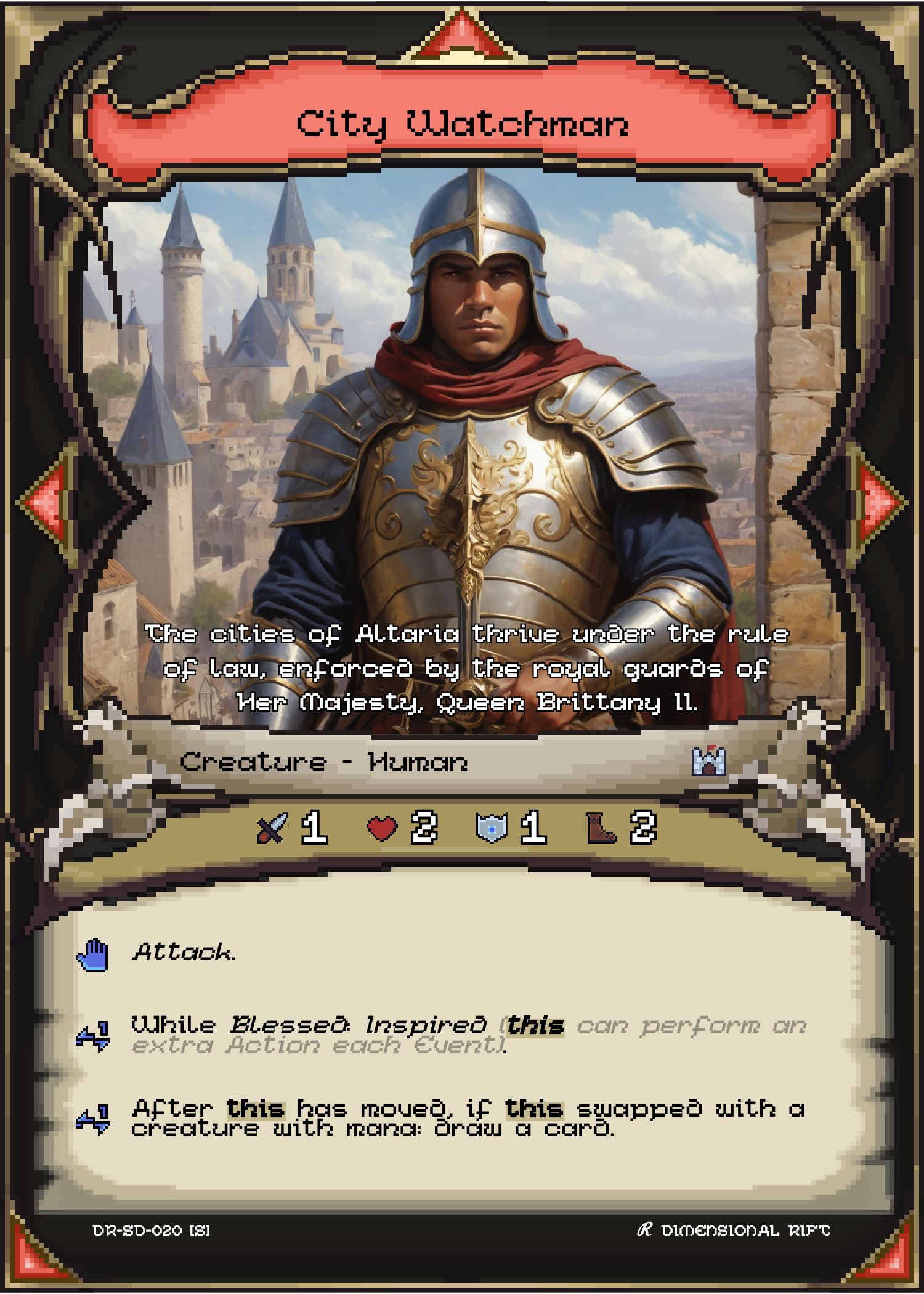
Creatures are the most brittle card type as they can be easily targeted by the opponent, and can also be attacked and destroyed by accruing damage. However, they are the most useful cards as the only ones that can Strike and reduce the opponent's HP, and thus a core component of any deck.
Unlike Artifacts, Creature cards played faced-down cannot be flipped directly (unless they have Ambush). As with any cards, they are automatically flipped at any point if they are targeted (be it by an attack or effect; be by you or your opponent).
Artifacts
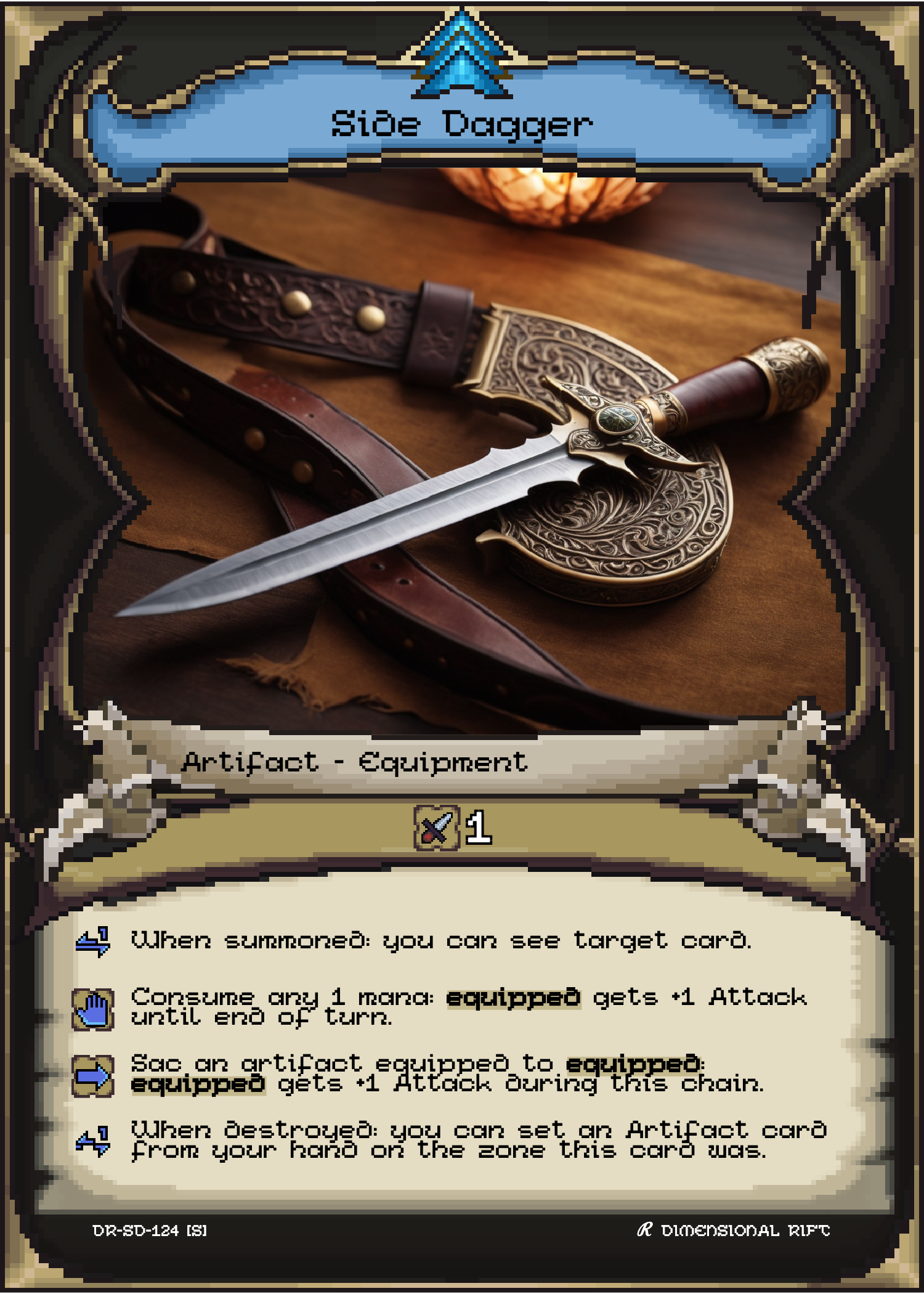
Artifacts are a bit more protected than creatures because they cannot suffer damage and can be harder to target (but can still be destroyed by your opponents effects or sacrificed by you).
Unlike Spell cards or Instants on other games, and very much like any other card in this game, unless otherwise stated, Artifacts remain on the field until they are destroyed by some effect; while some artifacts have continuous effects, activation effects, or triggers that can happen many times, others have one-of effects and essentially lock your zones (such as Scrolls), but can still used for sacrifice fodder.
There are a few sub-types of Artifacts with special rules:
Equipment
Equipments are artifacts that can be Attached to creature imbuing them with transferable properties (Might, Life, and up to one effect).
Every Equipment has the action Equip:
Equip: Attach [this] to target creature.
Once attached, an Equipment is no longer considered a separate card, and:
- cannot be targeted (but can be chosen if an effect specifies it);
- cannot have counters of any kind (damage, mana, conditions);
- cannot be unattached naturally (though effects might allow it).
When a card is destroyed, all attached cards are destroyed with it. Attachments can also be directly destroyed by certain card effects.
Scroll
Scrolls have a powerful, one-off, "When summoned:" trigger effect, and then are essentially clutter until they can be destroyed.
They have a special rule regarding their Will: unlike other cards, they do not acquire Mana counters when summoned; in fact their "mana" is considered "spent" when their effect activates. However, their can still be sac'ed face-down for their Mana cost via the Hidden Sacrifice rule, before they are ever flipped.
Monuments
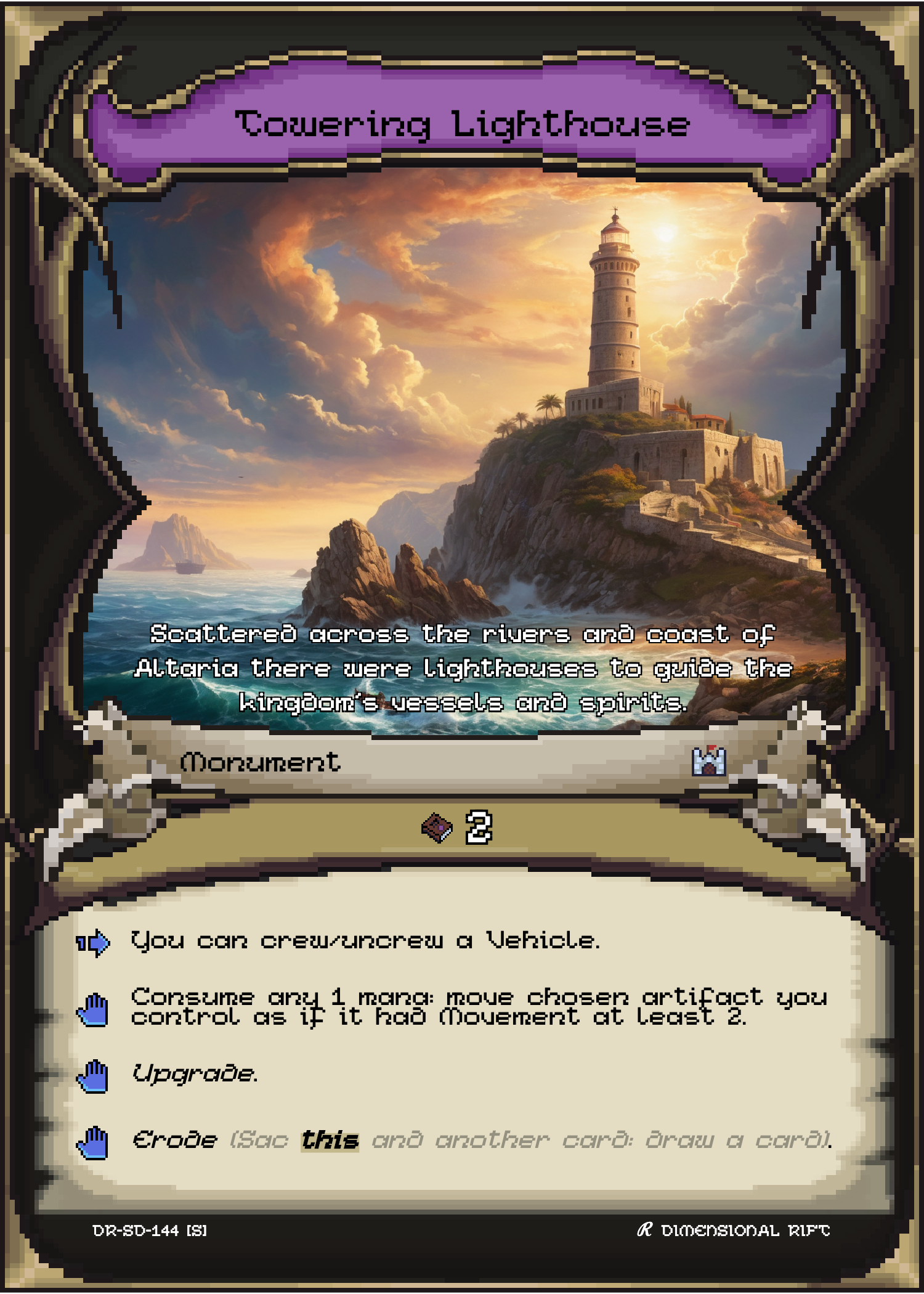
Monuments are extremely resilient as they cannot be targeted and do not interact with the targeting system. They are rare and you have only one Monument zone, and their effects affect the entire battlefield (including opponent's cards!).
Card Lifecycle
In order to prevent infinite loops and other broken shenanigans, Dimensional Rift observes a strict card lifecycle. While effects have full reign within these guidelines, rarely, if ever, they should be violated.