Rules
Note I have not taken care into properly writing and notably structuring these rules. Please forgiven the messy organization.
Flaky Flasks can be played by 2-4 players who compete to see who will be the best potioneer at the end.
Objective
The objective of the game is to have the most Fame at the end of the 12th round.
If tied for Fame, coins can be used as a tiebreaker.
Contents
The three main components of Flaky Flasks are:
- Cards - these are ingredients and coins and will be used by players to craft potions. Each player will have a starter deck (Tier 0 cards) and be able to purchase new cards from the Card River as they are unlocked.
- Tiles - these are hex pieces the players will use to build their board. Each player start with the singular Tier 0 tile and will be able to purchase new tiles from the Tile Tableau as they are unlocked.
- Panels - these represent the chemistry rules of the universe, and define which potions can be made. The Tier 1 rules are pre-determined, and new tiers will also be unlocked.
Other game elements include:
- Coins - amount of currency each player has; can be represented by physical coin tokens.
- Fame - victory points each player has; players can use dice or pen and paper to represent their current Fame.
- Fumes - a shared resource; can be represented by physical tokens; there are light and dark fumes.
Setup
For the initial setup, give each player:
- their starting deck (composed of 12 Tier 0 cards, the 9 unique ingredients + 3 Copper Coins)
- an empty board and the Tiler 0 tile (a straight 1-pipe piece)
- no coins / fame
Also setup:
- the Chemistry board with the Tier 1 Panels revealed
- the Tier 1 Card River
- the Tier 1 Tile Tableau
- no light nor dark fumes
- the Rounds and Turn trackers
Also, use a randomized method to determine the first player.
For the following rounds, the next player in turn order will be the first player.
Rounds
The game is played during 12 rounds, during each of which each player will be able to brew and sell up to two potions in order to acquire coins and fame.
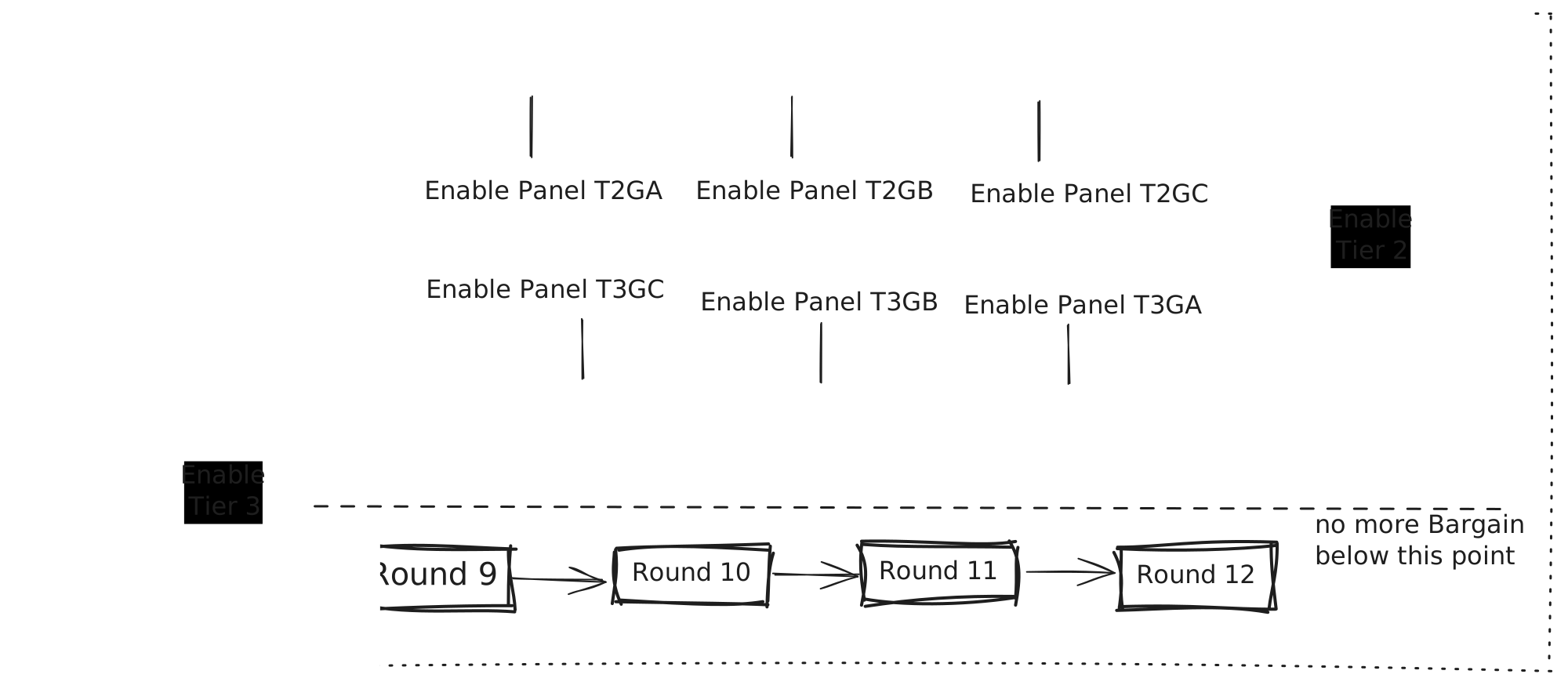
Every set of 4 rounds, a new Tier of cards and tiles is be unlocked; panels are unlocked one by one according to the diagram:
There are 4 tiers of components:
- Tier 0 are the cards and (single) tile on each player's starter deck (there are no Tier 0 Panels).
- Tier 1 are available at the start of the game (to purchase, for Cards and Tiles; or to use, for Panels).
- Tier 2 are unlocked right after Round 4 (or earlier for Panels).
- Tier 3 are unlocked right after Round 8 (or earlier for Panels).
Components are unlocked after the end of each round, before the next round starts.
Each round, a turn order is defined by the first player and the clockwise orientation.
Round Structure
Each round is a self-contained opportunity for players to play cards, propagate symbols, brew potions and sell them.
Each round is divided into some phases, and contains two Turns:

- Setup Phase: each player can rearrange their board, and consult their deck before shuffling it.
- Turn 1: play a Turn clockwise starting from the first player.
- Turn 2: play a Turn counter-clockwise starting from the last player.
- Cleanup Phase: players will discard and recollect their cards, clear any Charge or other temporary effects.
- Market Phase: players can take turns making financial transactions (either buying or selling).
- Bargain Phase: players can perform trades or deals with each other.
Each phase can either be run simultaneously by all players, or in turn order.
Detailed Phase Descriptions
Setup Phase
The Setup Phase is the first phase of the Round and can be run simultaneously by all players, as there is no interaction.
During this phase, players can reposition and rotate Tiles on their board to whatever configuration they prefer. They can leave tiles out.
Players can also consult their deck before shuffling it.
Turn Phase
See the Turn Structure below.
Cleanup Phase
The Cleanup Phase can be run simultaneously by all players, as there is no interaction.
Players must:
- any temporary effects (i.e. "until end of turn", etc) are cleared
- cleanup any Charge in their Player Board
- discard their Coins and put temporary coin markers on their wallet
- discard any other cards on their field, hand, or deck
- recollect their deck from the discard pile
Market Phase
During the Market Phase, players will will take turns in turn order to perform financial transactions.
A financial transaction can be either buying or selling something:
- Sell a Potion: to sell a potion, a player must first identify the Potion with a Panel, and then determine the amount of coins and fame they will receive. If there are multiple applicable rules, the player must at this moment chose which of the rules they will use.
- Buy a Card from the Card River: to buy a card, a player must pay its coin cost, and then has the opportunity of trashing a card in their deck if desired.
- Buy a Tile from the Tile Tableau: to buy a tile, a player must pay its coin cost (see Purchasing Rules).
Once you pass, you can no longer partake on this Market Phase.
Once all players pass, proceed to the next phase.
All potions are discarded after the Market Phase, so you cannot keep a potion to sell later.
After the Market Phase is completed, players proceed to the Bargain Phase.
Bargain Phase
During the Bargain Phase, players can perform trades or deals with each other.
In turn order, each player can propose any trade or deal with any other player. The other player can accept or refuse the deal.
Players can perform a mutually agreed deal to exchange any combination of:
Players cannot bargain Fame.
The Bargain Phase only happens before the Tier 3 unlock.
Once all players had their sub-turn, the Round ends.
Turn Structure
Each one of the two turns is divided into steps (some are simultaneous, some synchronous):

- Draw Step: each player draws 5 cards from their deck.
- Ritual Step: in turn order, each player during their turn can, as many times as they wish:
-
- discard an Ingredient Card to activate its Hex effect;
-
- after each effect activation, each player has priority (in turn order) to respond with Counter effects from their hand.
The following steps can be done asynchronously by each player if desired:
- Play Step: as many times as they wish, players will:
-
- play cards from their hand to their board, activating Manifest effects;
-
- or discard cards from their hand them to activate their Charm effects.
- Propagate Step: propagate any number of slotted ingredient cards through their board.
- Brew Step: players can optionally brew a Potion with the contents of their Cauldron.
- Discard Step: at the end of each turn, players must discard all unused cards from their hand.
The only synchronous step is the Ritual Step; other steps can be performed asynchronously by each player simultaneously.
Detailed Step Descriptions
Draw Step
The Draw Step is the first step of the Turn.
During the Draw Step, each players draws 5 cards from the top of their deck. That is now their hand.
After all players have drawn their starting hands for the turn, the Ritual Step immediately begins.
Ritual Step
The Ritual Step is the interactive step of the Turn, happening right after the Draw Step.
All effects that affect either other players or the global state of the game (such as Fumes) will be activated during this step; namely:
During the Ritual Step, players will act in turn order, essentially having a sub-turn; in each player's sub-turn, they can, as many times as they wish, activate a Hex effect by discarding an Ingredient Card from their hand that has a Hex effect.
Before resolving each effect, players get the opportunity to respond or pass priority, again in turn order, starting with the first player after the sub-turn player.
Typically, this process is vastly simplified because not all players will have or wish to use these types of effects every Turn. A simplified version would be each player declaring "no Ritual effects" in turn order, until say one player activates a Hex, and then players can declare responses simultaneously.
After all players had their sub-turn, the Play Step begins.
Play Step
The Play Step is a Turn step that happens right after the Ritual Step.
During the asynchronous Play Step, players can play cards from their hands in one of two ways:
- play a card (ingredient or coin) into one Slot in their board
-
- if the card as a Manifest effect, it triggers immediately and must be resolved
- discard a card with a Charm-type effect to immediately resolve its effects
After each player is happy with their board state, they can proceed to the Propagate Step.
Propagate Step
The Propagate Step is a Turn step that happens right after the Play Step.
During this step, players can propagate symbols through their board of ingredients cards that they have slotted.
For each ingredient card in play that the player wishes to propagate, they will process each symbol through their machine following any desired path until they reach their Cauldron.
Symbols that reach broken paths are voided. Otherwise, symbols cannot be voided and must be propagated all the way (unless a machine voids them).
During propagation symbols can be transformed by the tiles they encounter. For example, a ⬟1 symbol passing through a Catalyst Injector could become a ⬟3.
Players do not need to propagate every ingredient, as they can be saved for the next turn (unless the have the Spoils trait). However, once they decide to propagate a card, they must propagate all symbols on it (unless they have the Fractured trait).
After each player no longer wishes to propagate any more cards or symbols, they can proceed to the Brew Step.
Brew Step
The Brew Step is the penultimate step of a Turn, happening right after the Propagate Step.
During this step, each player can decide (or not) to brew one potion with the current contents of their Cauldron.
Players cannot pick a subset of symbols. Players cannot brew empty potions.
After each player made their decision, they can proceed to the Discard Step.
Discard Step
The Discard Step is the last step of the Turn, right after the Brew Step.
During the Discard Step, each player discards their entire remaining hand.
Players cannot keep cards in their hand between turns.
After the Discard Step is completed, the next phase of the current Round begins.
Potions & Symbols
The main path to acquire Fame is to brew and then sell potions.
A potion is an unordered collection of two or more symbols that have been brewed by (and belong to) a player.
It will only be identified with a potion "formula" (chemistry rule) when it is sold, at which time the brewer will acquire a certain amount of coins and fame.
Symbols are the atomic building blocks of potions. They come from ingredient cards and are processed and transformed by your alchemical contraption (your board of hex tiles) before being added to your Cauldron (this process is called Propagation). Finally, a player might brew a potion with the contents of their cauldron. They must use all symbols currently in their cauldron to brew a potion.
Symbols are atomic and uniquely defined by 3 characteristics:
- shape (▲, ■, ⬟)
- color (⬤, ⬤, ⬤)
- value (1 to 12, inclusive)
Note What was originally the "hexagon" symbol I am in the progress of migrating to a "pentagon" instead for a few reasons. The current status of this website is mixed, so please keep that in mind.
Notably important to understand that having two symbols or a symbol of value two is different. For example, you can have 1 ▲2 symbol as opposed to 2 ▲1 symbols. You can have duplicated symbols in potions.
Panels & The Chemistry Board
The Chemistry board contains the rules of chemistry for this run, i.e. how to make potions.
Each Panel is a particular rule that a potion might follow. When selling a potion, the player can decide which (if more than one) panel/rule they are using, and if their potion is valid under that rule, the rule will determine the amount of coins and fame that the potion can be sold for.
The Chemistry Board has 9 slots for Panels, 3 of each tier.
The Tier 1 Panels are always the same and start unlocked in the board.
The Tier 2 and 3 Panels are unlocked one by one according the round tracker diagram above.
Some symbols are used in Panel cards:
- ▲, ■, and ⬟ are used to represent the three symbol shapes (of any color)
- ⬤, ⬤, and ⬤ are used to represent the three symbol colors (of any shape)
- A combined shape and color can be used, for example, ⬟ means a red pentagon
- numbers in parenthesis are used to represent symbol values (for example,
(1)would mean a 1-valued symbol) - the
[#]operator means "amount of symbols (of type)" - the
[+]operator means "sum of values of symbols (of type)"
For example, the following panel:
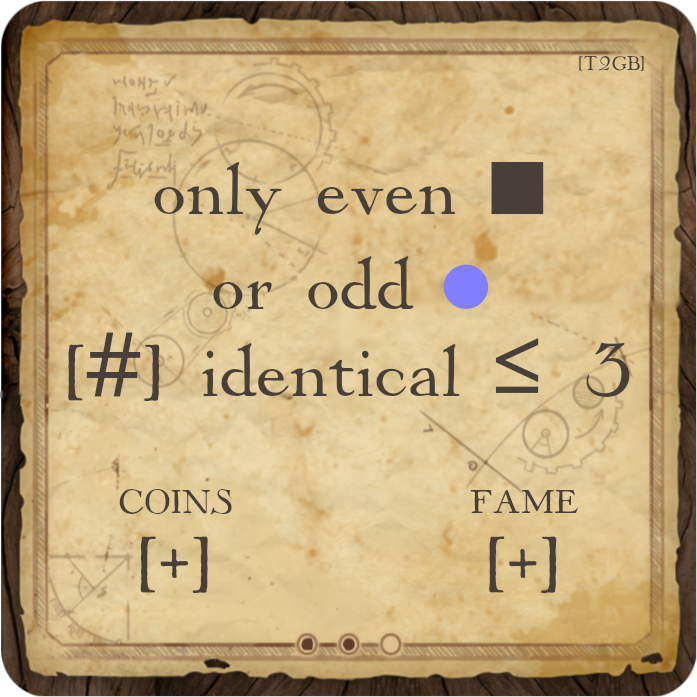
Means that a potion qualifies if:
- all symbols are either:
-
- square-shaped symbol with a even value;
-
- or blue-colored symbol with a odd value.
- there are at most 3 identical symbols
So a potion that could qualify for it could be ■2 ▲1 ⬟1, which would be worth 4 coins and 4 fame upon selling. A potion 2x■2 ■4 is also valid (worth 8 coins/fame), while a potion 4x■2 is not valid because it has 4 identical symbols.
Cards
Cards can be Ingredients or Coins. They can have Effects.
Effects can be one of 5 types:
During the Ritual Phase (these happen synchronously and typically affect other players or shared resources):
- Hex: can be activated by discard the card during the Ritual Phase. Typically they represent an attack or buff that affects you, other players and/or shared resources.
- Counter: can be played at instant speed during the Ritual Phase to respond to Hex or other Counter effects. Might or might not require discard or another cost.
During the Play Phase (these are done asynchronously by each player separately):
- Manifest: "When played" effects that trigger immediately when the card is played on your board. The card must be played to activate their Manifest effect, but it can be played on a non-connected slot.
- Charm: "When discarded" effects that you can choose to activate (instead of Playing) from your hand during the Play Phase.
- Trait: a "continuous" / "passive" trait that an ingredient has.
Some effects can exude fumes (either light or dark) or might care about fume dominance. Fumes are two shared global resource, light fumes (denoted by ≋) and dark fumes (denoted by ≋). At any given time, a certain amount of each fume is present. Cards that exude fumes will increase the amount of fumes of one of the types. At any given time:
- if there are more ≋ than ≋, ≋ are said to dominate.
- if there are more ≋ than ≋, ≋ are said to dominate.
- if there are no fumes or if there are an equal amount of fumes, there is no active dominance.
Tiles
Tiles are placed on your board and compose your alchemical contraption that allows you to brew potions.
- power and charges
- io bands (symbols, liquids, power)
- slots
Purchasing tiles:
- a tile of tier X costs X+1 coins
- when you buy a pipe, you receive a random pipe piece
- the first pipe you buy each round costs 1 less
- [for 4 or more players] you can only buy one of each machine