Quick Start
Note This Quick Start Guide is still being developed and fine-tuned. While the full rules will explain everything you need in details, this page might be confusing or lacking.
This is a simplified version of the rules covering only key points to get you started with the game. This assumes you have a cursory understanding of TCGs in general.
Dimensional Rift is a Yu-Gi-Oh!-inspired TCG in which cards are played to specific zones in the Battlefield (a 5x2 grid for each player).
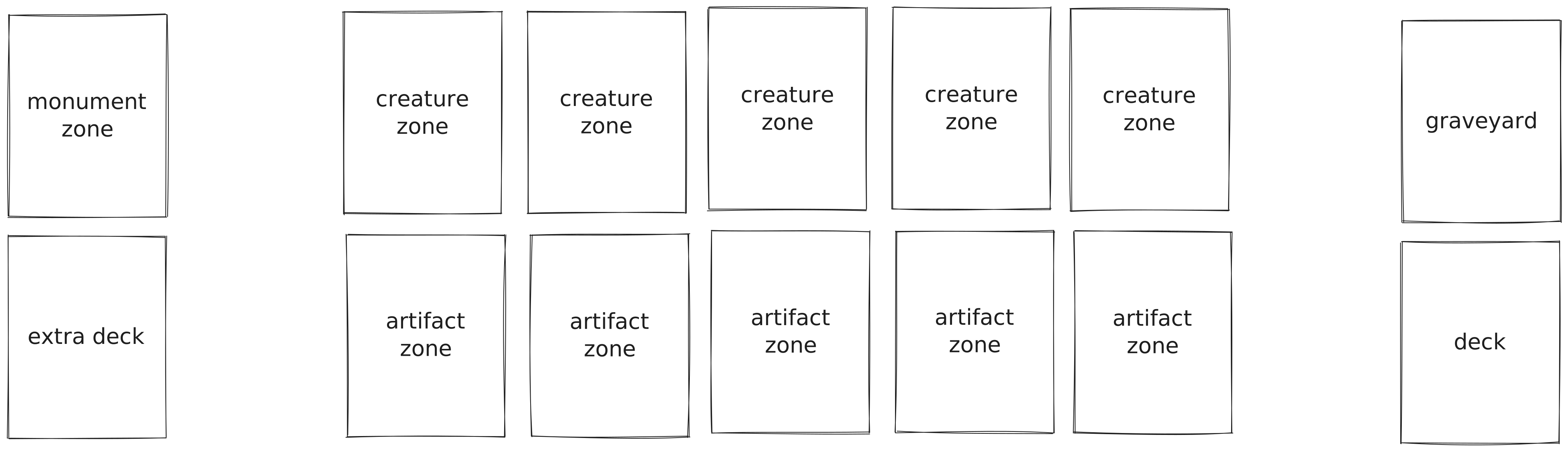
There are 3 types of cards, Creatures, Artifacts and Monuments. They each can only go on their dedicated zones, and they can be played either Face-Up or Face-Down (except Monuments, which are always face-up).
Creatures and Artifacts have arrows that indicate which direction they can target (both for effects and actions, such as Strike). You can only target cards that your card connects to. You can use the arrows printed on the card plus its current orientation and position on the grid to determine which zones it connects to. You can check the wiki on Targeting for more details on how the arrows work - but for now you can use the interactive application below to get yourself familiarized with the concept:
↖
↑
↗
←
·
→
↙
↓
↘
Non-artifact zones on the battlefield must be Conquered before they can be used (all artifact zones are always active). Each turn, if they choose to take the Campaign Event, they can Conquer one new zone. If there are no more zones to conquer, they can draw a card instead. It is of strategic importance to quickly start to active your creature zones so that you can Strike and block your opponent attacks by playing creatures.
Your turn has 2 relevant phases: the Event Phase, in which you can use Actions and must pick either Campaign Phase or Battle Phase; and the Deployment Phase, in which you can play cards onto the battlefield.
During your Event Phase, each card you control on the field, one by one, in any order, can perform at most one Action chosen from their Action Pool. The choice of event can give bonus action options to the Action Pool of all your cards:
- Campaign Event: the first one you want to take. Conquer a new zone and all your creatures get the March Action.
- Battle Event: all your creatures get the Strike Action, and they have First Strike against active blockers.
All creatures always have the Reorient action available, allowing them to rotate in place regardless of event choice.
You win by reducing your opponent's life from 6 to 0. You can do that by striking with your creatures while not being blocked. When you hit your opponent, they draw a card. There is no alternative Win Conditions. Players do not lose by decking out.
Game actions can be either Slow Speed (sorcery speed) or Fast Speed (instant speed):
- slow (during Deployment Phase): Summon or Set cards from your hand, Summon at most one card per Deployment from your Fables Deck
- slow (during Event Phase): perform one Action per face-up card you control on the field, such as Strike, March, Reorient, or additional actions they have in their Action Pool
- fast (any time): activate any effect from cards already on the field; flip Artifact cards face-up
Simple Game Flow
- Decide who goes first using Jan-Ken-Pon (the winner decides who goes first).
- Each player starts by drawing 5 cards, and then can Mulligan in turn order.
- The first player will take the Campaign Event and choose a zone to activate; then during their Deployment Phase, they can choose to Summon or Set one card to that zone plus any Artifacts they want; finally, they draw a card to end their turn.
- Turns continue alternating; on your second turn, you will have a meaningful choice between Campaign Event and Battle Event.
Notes
- There is no Summoning Sickness, but due to turn structure, you only get to act with cards the next event after they are deployed.
- While you can flip Artifacts at instant speed (as part of resolving any of their effects, or for any reason), creatures must be targeted in order to be flipped (unless they have Ambush).
- You can only Summon, Set, or March targeting Conquered zones you control. But you can Strike targeting any creature zones.