Turn Structure
At the start of the duel, each player must shuffle their Main Decks and offer for the opponent to optionally cut.
They also should setup the field and play area accordingly so that both players are clear on where each zone is.
Then, players must play Jan-Ken-Pon (rock, paper, scissors) until one player wins; that player immediately picks who is going to start the game. If this not the first game of the match, and the previous duel had a losing player, that player gets to pick instead.
After that, each player will draw 5 cards from their Main Deck onto their hands (this is their starting hands).
Each player can then take turns to Mulligan until they are both satisfied. The Mulligan rule is: set aside the current hand and draw a new hand of X - 1 cards. After all rounds of Mulligan, shuffle the set-aside cards and the rest of the deck together.
Turn Phases
Turns are divided into a sequence of phases that must be followed in order:
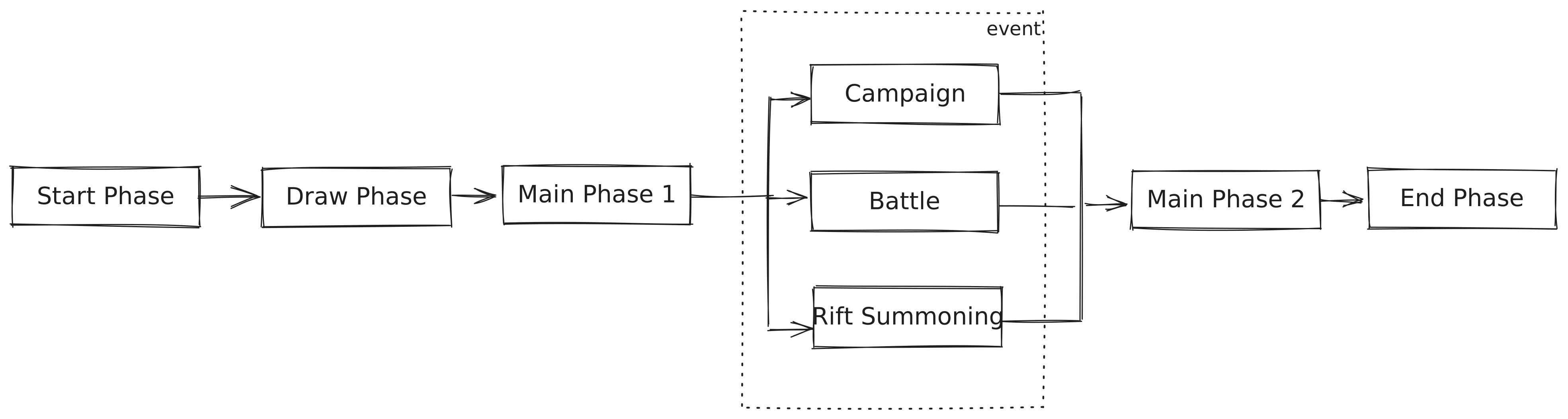
Begin Phases
Nothing happens a priori during this phase, but it serves as a point of reference for effects that trigger at the beginning of the turn or other Fast Speed effects. The turn player must then choose their event in order to proceed to the Event Phase.
Event
The turn player must pick one Event to perform that turn: Campaign Event or Battle Event. This choice must be made immediately at the start of the Event Phase and cannot be changed later for the turn.
Regardless of the choice, during the Event Phase, the turn player can have each of their face-up cards on the battlefield perform one Action at Slow Speed. No cards can be played from the hand or extra deck during this phase, except for effects that explicitly allow it (such as Transform or Conscript).
Campaign Event
At the start of a Campaign Event, the turn player must choose one of their inactive creature or monument zones to conquer (represented by putting a marker onto it). If they have already conquered all their 6 non-artifact zones, they must draw a card instead. This must be done immediately when starting the Campaign Event.
As a bonus for having chosen this event, every face-up creature the player controls gets the March Action added to their Action Pool.
Then the player can proceed to perform Actions with their face-up cards as part of any Event Phase.
This is certainly the first event a player will choose in a duel, because at the very first turn they won't have any creature available to benefit from the Battle Event.
Battle Event
As a bonus for taking the Battle Event, every face-up creature gets the Strike Action added to their action pool.
Then the player can proceed to perform Actions with their face-up cards as part of any Event Phase.
Deployment Phase
During this phase, the turn player can perform the following Slow Speed game actions:
- Summon or Set cards from their hand onto valid, conquered zones they own;
- Summon up to one card from their Fables Deck onto valid, conquered zones they own.
Draw Phase
This is the "end phase" of the turn; other than Fast Speed effects and triggers, the turn player must draw one card from their Main Deck into their hand. This is mandatory if there are any cards left to draw (but decking out does not cause game loss).