Overview
Dimensional Rift is a 2-player competitive card game in which two opponents challenge each other in a battle of wits, strategy and luck with TCG-inspired (in particular, heavily Yu-Gi-Oh!-inspired) mechanics. Each player has both a Main and Fables Deck and play cards on specific zones that they conquer in a battlefield, slowly building their board towards a final push to reduce the opponent's Hit Points (HP) from 6 to 0.
If you want to read more broadly about our design philosophy, or "why yet another TCG", check out Principles page. If you are familiar with TCGs in general and want to jump straight into action, check our Quick Start page.
Deck Building
For now, we are building 4 closed starter decks belonging to the 4 initial factions (Men, Fey, Telur, and Wynn); once the base mechanics are in place, we will consider deck building, drafting, distribution and other such topics.
Duel
The core of gameplay is a duel, a single unit of competition between two opponents. A duel is a sequence of rounds in which each player takes a turn in order until one player reaches 0 HP and loses (and the other, therefore, wins).
In their turns, players go through phases, in which they are allowed to (following their rules): choose an Event Phase and act with their cards in the battlefield; play cards from their hand during the Deployment Phase; activate different types of effects, and finally, draw a card to end their turn. Players also draw a card when taking a direct hit to their HP.
The main strategy is to conquer creature zones during the Campaign event in order to summon creatures during the Deployment phase and attack the opponent during the Battle Event, overcoming their creatures, if necessary, eventually, reducing their HP to zero. Players must be careful to avoid face-down cards setup by the opponent as they can cause long chains of effects that put a twist into the game. Use the resources you draw wisely and obliterate your opponent's army.
Most cards, being creatures, artifacts or monuments, have one or more effects of different types to be applied in a myriad of ways. Some effects require the arrows in the card to point to targets, so positioning cards correctly is crucial. In general, card effects supersedes this ruleset (i.e. cards will add exceptions to the rules described here). Unleash powerful boss cards from your Fables Deck during the Deployment phase. Use their soul-crushing effects to put an end to your opponent's ploy (and their life).
Game Pieces
While fundamentally only two decks are needed to play, some extra pieces and supplies might enhance the experience with the game:
- sleeves and deck boxes to keep cards tidy
- 2 6-sided dice to track players' HP
- other kinds of dice, beads, or markers to represent temporary effects on cards on the field (such as mana and damage counters, conquered zones, or conditions).
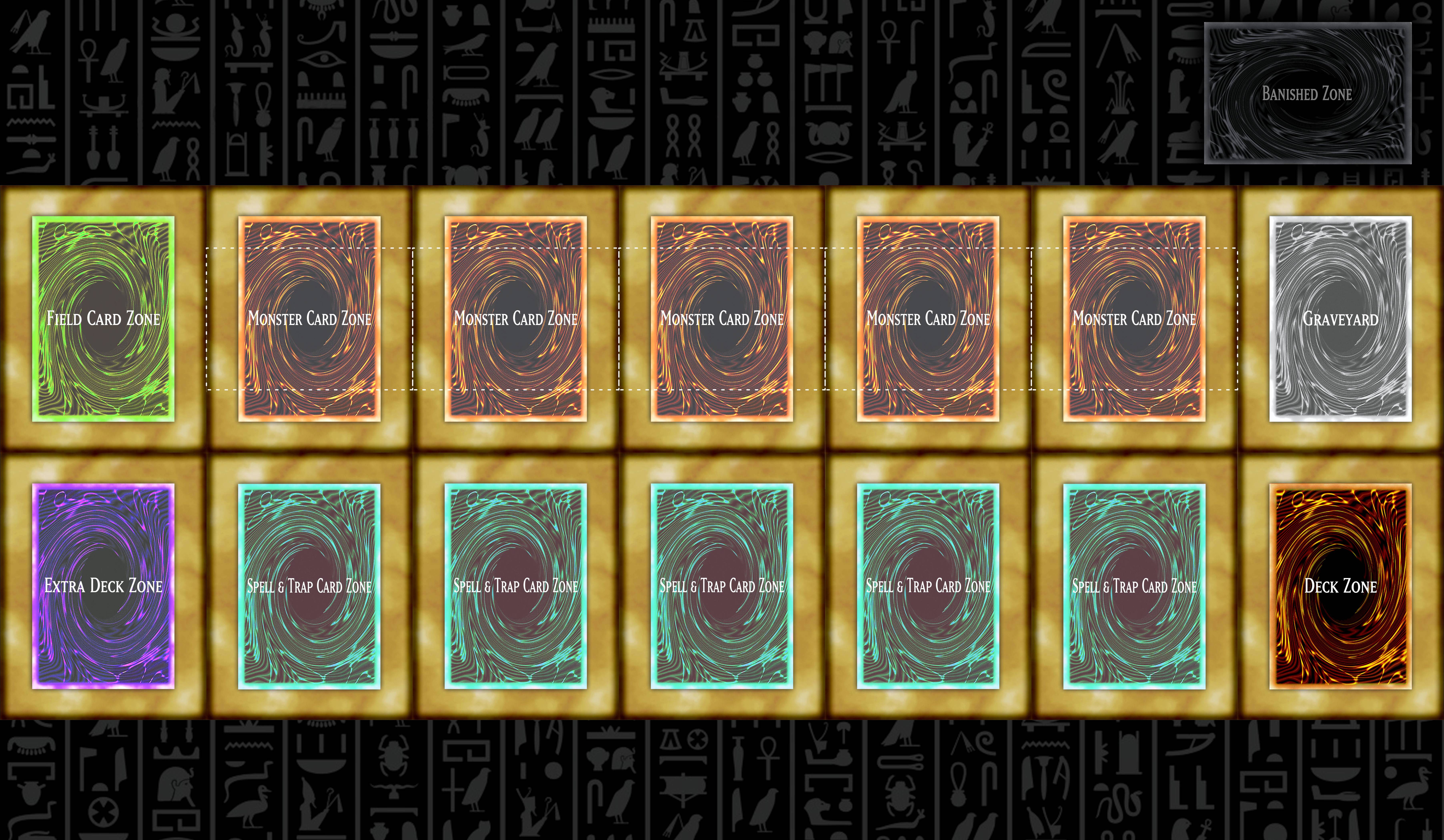
- an Dimensional Rift (or Yu-Gi-Oh!) playmat is highly recommended as the position each card on the battlefield is extremely relevant; but one can certainly use good alignment and imagination (or just draw one!)
Places
At any moment in the game, each card has to be in one place. Game actions might allow players to move specific cards from one place to another under various circumstances. There are a few places in which cards can be other than the battlefield:
- Main Deck (each player has one): non-Fabled cards start here. This is a facedown pile of cards in which order is relevant. This is secret to all players. Cards are drawn from the top of this pile.
- Fables Deck (each player has one): Fabled cards start here. This is a facedown pile of cards with no relevant order. Each player can consult their own Fables Deck at any time (but not the opponent's). Usually Creature Token cards are kept here (though they are not considered Fabled).
- Graveyard (each player has one): cards that are no longer on the field usually are moved to the graveyard. This is a faceup discard pile of cards with no relevant order (but usually should be kept in the order cards are added, new cards being added to the top). Once a card hits a Graveyard, it will stay there until the end of the duel. Both graveyards are public and can be consulted by any players at any time. There are no effects that interact with the Graveyard, so it serves at most as a live log of events.
- Hand (each player has one): players draw cards from their decks to their hands. Normally, players hold their hands in their hands because it's a small amount of cards. They have no order and are secret to the the opponent. You should hold these cards facing yourself so that the opponent can only see their non-descriptive backs, while you get to see what they are.
The Battlefield
Cards are played from the hand (or Fables Deck) to the battlefield. The battlefield is a single place but has two sides, one for each player, which are mirror images from each other. The field is composed by specific zones in which some cards might be able to be played (typically one per zone). Cards must be played on valid zones to be on the battlefield.
Each side of the field consists of two rows of 5 zones on top of each other; the one closer to the opponent contains the creature zones, and the one closer to you has the artifact zones (very similar to a Yu-Gi-Oh! board). There is also an 11th, separated Monument zone for each player, that is on the field but not considered adjacent to anything, and thus cannot be targeted or target anything. Monuments do not interact with the targeting system (they might use the word choose instead).
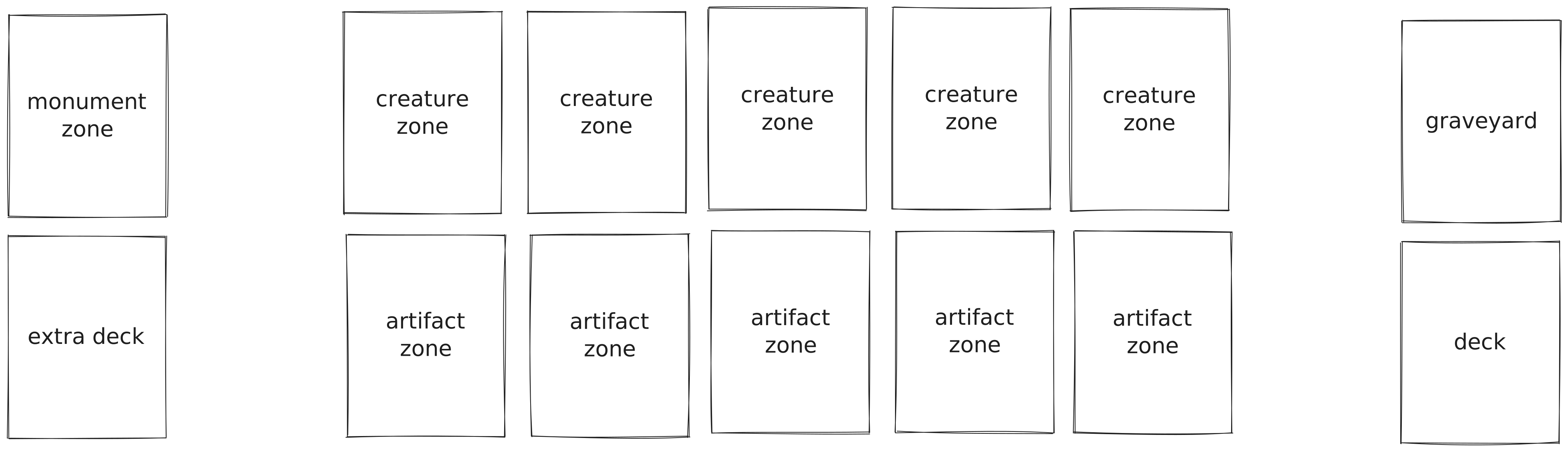
Compared with an old school Yu-Gi-Oh! board, the following substitutions can be applied to derive the Dimensional Rift battlefield:
- monster zones ➙ creature zones
- spell/trap zones ➙ artifact zones
- field zone ➙ monument zone
- deck, extra deck and graveyard are the same
- there is no banishment in Dimensional Rift